Research question
Are artists’ concerns equitably represented in public discourse about AI-generated art, or does the broader conversation systematically underrepresent and distort the issues artists care about most?
Methodology
Research was conducted using both quantitative and qualitative methods. The quantitative component measures the gap from the outside: public discourse on AI art from 2013 to 2025, including news, podcasts, legal filings, and research was mapped into a semantic space. Then, 1,259 survey-derived statements from artists were projected into that same space to test how well the two align.
The qualitative component consists of interviews. Every interview was recorded, transcribed, and edited for readability.
Paper · submitted August 2025When Algorithms Meet Artists: Semantic Compression of Artists’ Concerns in the Public AI-Art Debate
Ariya Mukherjee-Gandhi & Oliver Muellerklein
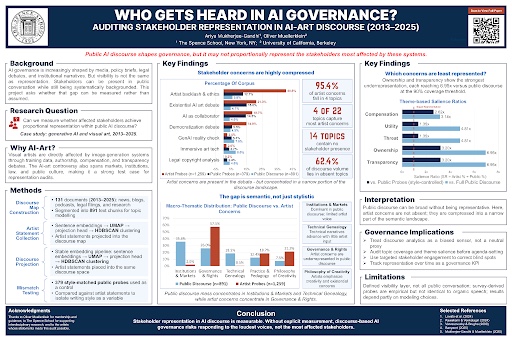
Artists occupy a paradoxical position in generative AI: their work trains the models reshaping creative labor. This study tests whether their concerns achieve proportional representation in public discourse about AI. Analyzing public AI-art discourse from 2013–2025 and projecting 1,259 survey-derived artist statements into the same semantic space, it finds that 95% of artist concerns cluster into just 4 of 22 discourse topics, and that 14 topics — 62% of the discourse — contain no artist perspective at all. The compression is selective rather than incidental: governance concerns such as ownership and transparency are 7× underrepresented, while affective themes like threat and utility are only 1.4× underrepresented once style is controlled for. The paper introduces a consensus-based semantic projection methodology intended to generalize beyond art to other stakeholder-technology contexts.
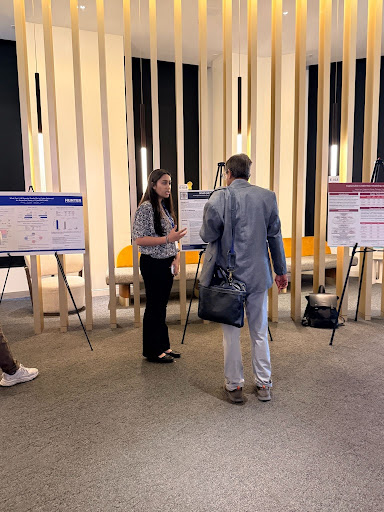
Poster Presentation at AASF Aix Summit · April 15, 2026
Auditing Stakeholder Representation in America’s AI Future
Public discourse plays a central role in shaping AI governance, regulatory priorities, and institutional response. Yet it remains unclear whether affected stakeholders achieve proportional representation within that discourse.This project introduces a computational framework for auditing stakeholder representation gaps.