Sougwen Chung
Sougwen Chung, Human-machine collaboration Artist & researcher · New York City & London
Sougwen 愫君 Chung is a Chinese-Canadian, nonbinary artist and researcher whose practice explores collaboration among humans, machines, and living systems. Working across drawing, painting, performance, robotics, artificial intelligence, and biosensing, they are best known for the long-running project Drawing Operations Unit: Generations (D.O.U.G.). Their work MEMORY entered the Victoria and Albert Museum’s permanent collection as the first AI model acquired by a major cultural institution. They founded the London-based studio SCILICET in 2019 and have received a TIME100 Impact Award..
For more than a decade, Sougwen Chung has explored machines as creative partners. Through robotic drawing systems trained on their personal archive, brainwave-responsive performances and experiments with silk-based conductive materials, Chung creates work in which authorship is shared across bodies, technologies and living systems. Their 2026 exhibition RECURSIONS 遞迴 brings these ideas together in a monumental live drawing at Art Basel Hong Kong, transforming decades of gestures into an evolving conversation about memory, identity, consent and care. At its heart, Chung’s practice offers a compelling vision of technology shaped through intimacy, mutual influence and the unpredictable act of making together..
The Hand, the Machine, and the Space Between
Sougwen Chung has spent a decade teaching robots to draw. Their work asks what technology might become when creativity begins with relationship, memory, and care
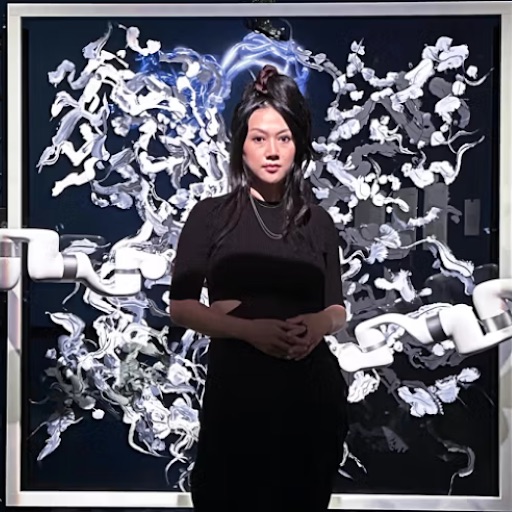
At Art Basel Hong Kong, a robotic arm moves across a ten-metre scroll of linen. It draws from decades of Sougwen Chung’s gestures while responding to signals from the artist’s body. Ink gathers where human movement meets machine interpretation. The resulting marks belong to a shared process whose authorship cannot be cleanly divided.
The performance forms the centre of RECURSIONS 遞迴, Chung’s 2026 exhibition with Fellowship and ARTXCODE. It is their first solo booth at the fair and the latest chapter in an inquiry that began more than a decade ago: What happens when a machine enters the studio as a creative partner?
For Chung, the question has never been abstract. They have built the robots, trained the models, collected the bodily data, and stood beside the machines as they moved. The work has unfolded through drawing, painting, sculpture, performance, neural networks, brainwave sensors, silk proteins, and countless hours of rehearsal. Every iteration leaves a physical record of an evolving relationship.
Chung calls this field of practice “co-aesthetics.” The term describes cognition distributed across human and machine bodies, with each participant changing the conditions of creation. It also offers an escape from the exhausted public argument over whether artificial intelligence will replace artists. In Chung’s studio, technology becomes intimate, fallible, and strangely alive.
Learning the nonhuman gesture
Born in Canada and raised partly in Hong Kong, Chung grew up with both musical instruments and computers. Drawing eventually became the thread connecting those early interests. Its “A drawn line registers pressure, speed, hesitation, breath. It maps not just where the hand went but how it felt to be there.”¹
That sensitivity to gesture shaped the first Drawing Operations experiments. In 2015, as a research fellow at the MIT Media Lab, Chung began developing a robotic drawing system called D.O.U.G., short for Drawing Operations Unit: Generations. The name quietly acknowledges AARON, Harold Cohen’s pioneering art-making computer program, while establishing a different kind of relationship between artist and system.
Each generation of D.O.U.G. introduced a new form of feedback. Early robots followed Chung’s movements. Later systems learned from the artist’s archive, responded to public data, or translated biosignals into mechanical action. The machines became neither servants nor independent personalities. They operated as bodies with their own rhythms, limitations, and capacities for surprise.
In 2016, Chung trained a recurrent neural network on roughly two decades of their drawings. The resulting project, MEMORY, allowed a robotic system to recall and regenerate gestures from the artist’s past. The Victoria and Albert Museum acquired the work in 2022, describing it as the first artificial intelligence model to enter the collection of a major cultural institution.
The achievement carried an unsettling emotional charge. Drawing with the system could feel like encountering an earlier self through movement. It could also feel cold and uncanny, as if a private history had been broken into statistical weights and returned through a mechanical body.
To create a machine collaborator, Chung first had to turn their own life into legible data.
“To make a machine collaborator, I’ve had to become machine-readable.”²
That is one of the defining tensions of contemporary life. People submit their movements, preferences, faces, voices, and relationships to computational systems every day. Chung brings this process into the open. Their data is deliberately gathered, carefully maintained, and transformed within an artistic practice whose terms they have designed.
This makes Chung’s work especially significant in an era of generative systems trained on enormous collections assembled without meaningful consent. Their models grow from a personal archive and from works created jointly with D.O.U.G. Authorship becomes recursive. New gestures emerge from old ones, then return to the archive as material for future collaboration.
A body in the loop
With Spectral, Chung brought the feedback loop closer to the nervous system. A custom sensor reads the artist’s brainwaves while robotic painting arms respond across a transparent surface. Alpha-wave activity, associated with relaxed attention and creative flow, influences the robot’s movement. The artist observes the machine, adjusts internally, and receives its response in turn.
The installation turns meditation into a visible circuit. Thought does not simply issue a command. It enters an exchange among attention, software, hardware, pigment, and muscle memory.
At the 2025 World Economic Forum in Davos, Chung presented a new movement from Spectral. They described their increasingly refined alpha state as part of the artwork itself. The emphasis on process matters. The public sees a person and a robot painting together, yet the deeper work lies in the system of attention that makes the encounter possible.
Chung’s machines also challenge the fantasy of technological perfection. Robotic components age. Software becomes obsolete. Sensors fail. A system regarded as cutting-edge can turn archival within a few years. After a decade of Drawing Operations, the project has become a record of technological time as much as artistic development.
“Decay is just evolution in reverse.”³
This awareness has widened Chung’s practice beyond robotics. Recent works incorporate living systems, particularly Bombyx mori, the domesticated silkworm. Chung has raised the insects in the studio and observed their passage from egg to larva, cocoon, and moth. The relationship requires patience and care. Biological time refuses the speed promised by technological culture.
Silk carries its own contradictions. It is delicate and remarkably strong, ancient and newly relevant to biotechnology. Chung processes proteins from silkworm cocoons into biocompatible materials that can be combined with conductive substances. In the paintings from RECURSIONS, a bio resin-based metallic ink containing pure silver micro particles and silk fibroin meets a water-based calligraphic ink. The chemically incompatible materials push against one another. Their resistance gives the surface depth and structure.
The technique places robotics inside a much older history of bodies, labour, trade, and transformation. It also connects Chung’s Chinese heritage with a practice shaped by contemporary computation. Tradition survives here through use, pressure, and revision.
Recursion as a portrait of time
At the heart of RECURSIONS is RECURSION 0, the monumental scroll completed through live performance. A model trained on Chung’s gestural archive responds to incoming biosensor data as the artist works. Human intention and machine response accumulate across the linen.
Nearby, RECURSION Dataset 1314 (For a Lifetime) carries drawing and brainwave data across a suspended LED mesh. The number 1314 invokes a Chinese homophone associated with the phrase “one lifetime.” Attention becomes light, held briefly before changing again.
The exhibition’s title names its governing logic. In mathematics and computing, recursion occurs when a process refers back to itself. In Chung’s practice, the return is bodily and historical. A gesture becomes data. Data produces another gesture. That gesture joins the archive. The artist meets traces of their former movements through a system that continues to alter them.
Chung has called this condition an “aggregated abandon,” a phrase that captures both surrender and intense self-documentation. The work requires releasing control while preserving years of personal information. The artist steps beyond the singular self by building an unusually detailed record of it.
The contradiction remains visible. Chung has little interest in resolving it. Their paintings hold physical calligraphy beside computational abstraction. Their performances place ancient materials in contact with neural networks. Their machines can surprise, though they do not possess human consciousness or emotion. Each part retains its difference while participating in a common event.
This approach has led Chung toward a broader framework they call Operational Art. It encompasses the protocols, thresholds, ethics, and sequences that make co-creation possible. The artwork includes the conditions of relation: who designed the system, whose data shaped it, what materials sustain it, what forms of agency it permits, and how its participants remain accountable to one another.
“Human agency is neither privileged nor collapsed.”⁴
The sentence offers a concise ethic for an age of intelligent machines. Human presence remains consequential. Machine behaviour also changes the work. Agency moves through the arrangement without settling permanently in one place.
The unfinished relationship
Chung’s art arrives during a cultural moment saturated with claims of technological autonomy. Companies promise systems that can generate, decide, and act with decreasing human involvement. Chung’s robots tell a more complicated story. They require maintenance, training, attention, and negotiation. Their meaning grows from contact.
That emphasis on relationship gives the work its emotional force. Watching Chung draw with a robot can evoke the intimacy of a duet. One body anticipates another. A line begins, hesitates, and finds a response. The encounter contains risk because neither participant determines the whole.
The beauty Chung sought in a “nonhuman move” has grown into a sustained philosophy of coexistence. Their machines hold echoes of past drawings. Their sensors register fleeting states of attention. Their biomaterials connect technological research to the life cycle of an organism. Across these systems, intelligence appears as something distributed through bodies, tools, memories, and environments.
The robot’s mark does not announce the disappearance of the human hand. It reveals how many histories already travel through that hand. The machine adds another rhythm to the composition.
Chung’s work leaves us with a demanding possibility. Technology can be shaped through intimacy, responsibility, and care. Collaboration requires attention to difference, dependence, and change. It remains unfinished by definition.
On the long linen scroll, the lines continue to gather. Each gesture carries the memory of another. The work advances by returning, and the future appears as a relationship still being drawn.
Notes:
Sougwen Chung, interview by Anika Meier, “The Beauty of a Nonhuman Move,” The AI Art Magazine, no. 3 (2026).
Sougwen Chung, interview by Amber Hanson, “Sougwen Chung,” Sursuma, May 17, 2025
Chung, “Sougwen Chung.”
Sougwen Chung, interview by Peter Bauman, “Sougwen Chung on Aggregated Abandon,” Le Random, March 23, 2026
Bibliography:
Anteism Books. “Ecologies of Becoming: Sougwen Chung.” Accessed August 30, 2026. https://www.anteism.com/shop/ecologies-of-becoming-sougwen-chung.
Bauman, Peter. “Sougwen Chung on Aggregated Abandon.” Le Random, March 23, 2026. https://www.lerandom.art/editorial/sougwen-chung-on-aggregated-abandon.
Chung, Sougwen. Interview by Anika Meier. “The Beauty of a Nonhuman Move.” The AI Art Magazine, no. 3, 2026. https://www.art-magazine.ai/edition/number-three.
Fellowship. “Sougwen Chung: Art Basel Hong Kong 2026.” March 2026. https://fellowship.xyz/exhibition/artbasel-hk-2026-sougwen-chung-recursions.
Hanson, Amber. “Sougwen Chung.” Sursuma, May 17, 2025. https://www.sursuma.com/magazine/sougwen-chung.
Hube Magazine. “Sougwen Chung: The Poetics of Human–Machine Interaction.” 2025. https://hubemag.com/sougwen-chung-the-poetics-of-human-machine-interaction.
Jebb, Louis. “Sougwen Chung: Meet the Boundary-Pushing Pioneer of Robot Art.” The Art Newspaper, January 17, 2025. https://www.theartnewspaper.com/2025/01/17/sougwen-chung-meet-the-boundary-pushing-pioneer-of-robot-art.
Peh, Clara Che Wei. “Zero 10’s Asian Debut Brings Technology-Forward Art to a Switched-On Region.” Art Basel, March 16, 2026. https://www.artbasel.com/stories/zero-10-asia-artists-technology-art-basel-hong-kong.
Artwork
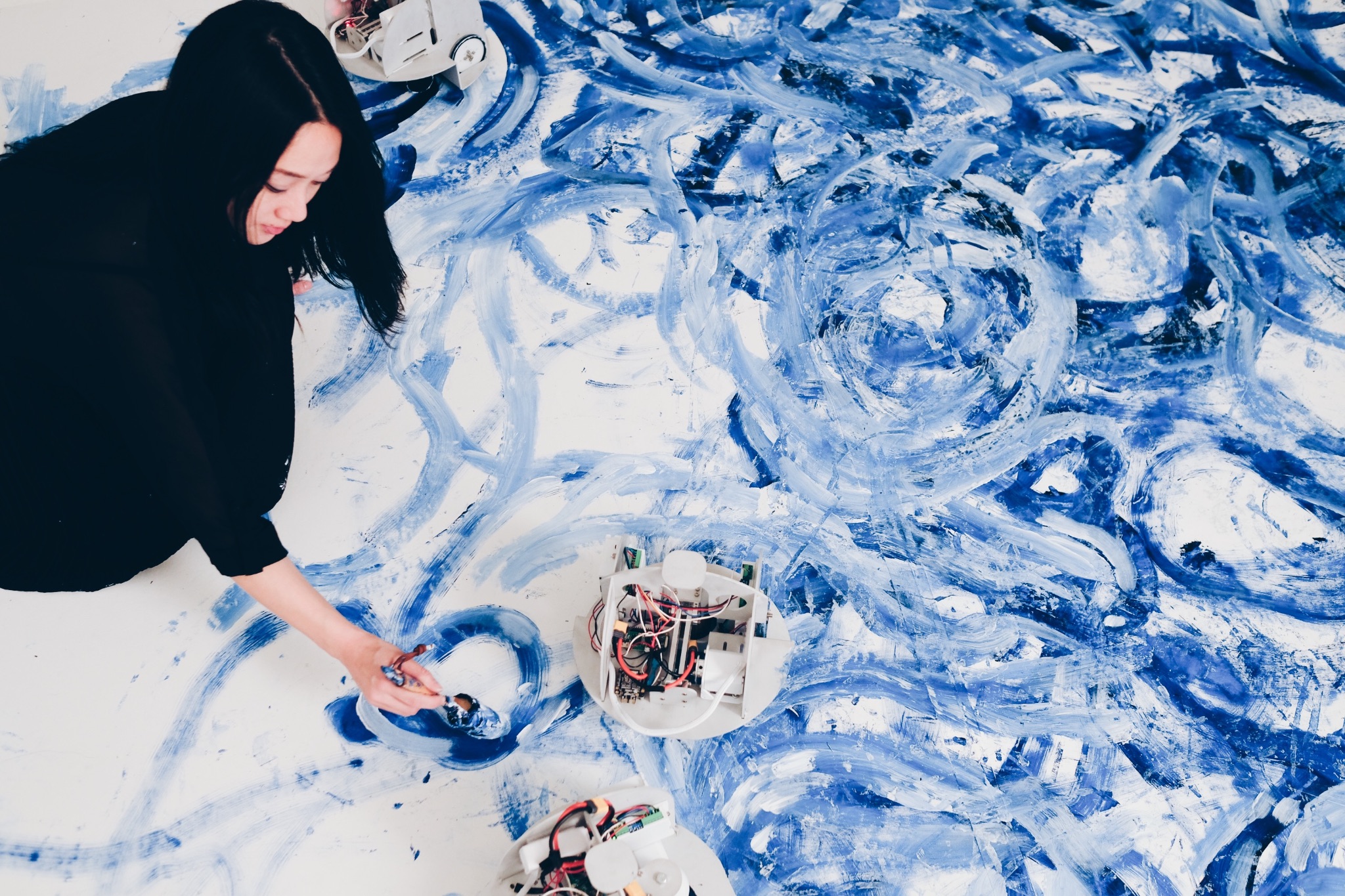
Image courtesy of Sougwen Chung
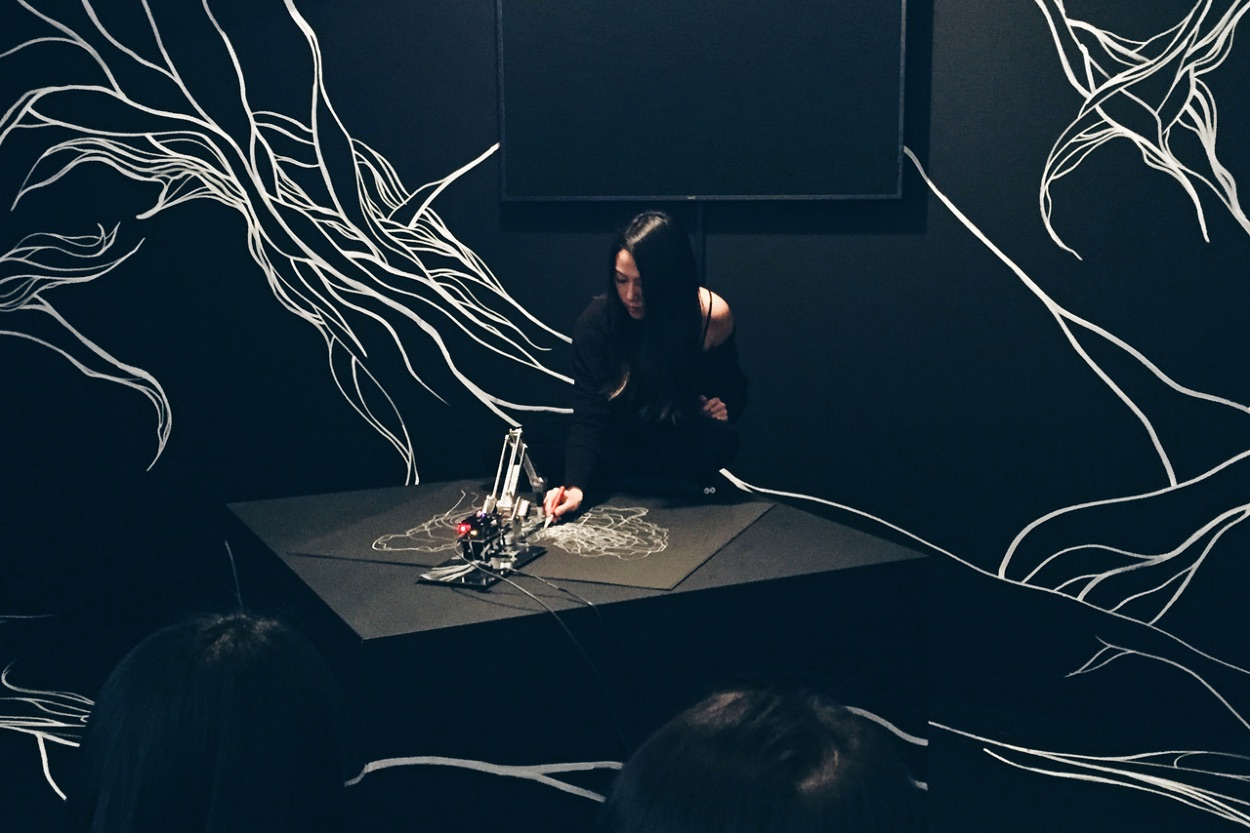
Image courtesy of Sougwen Chung
Traceable, traceableart.org/interview-sougwen-chun.html