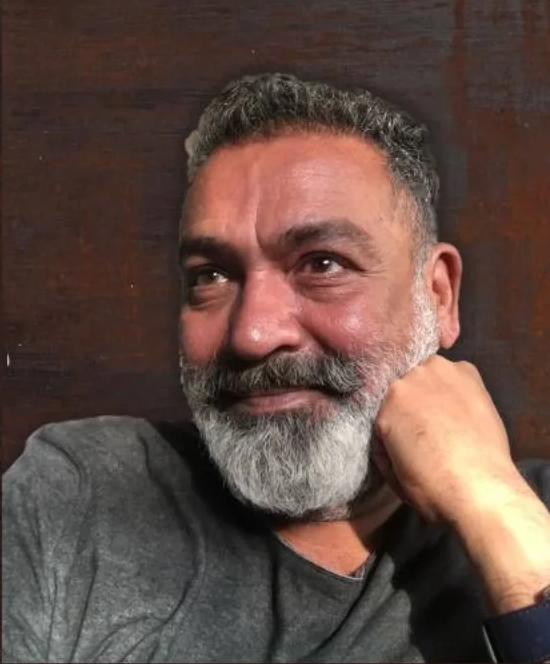
The idea has to be mine. The way of seeing has to be mine. AI can help make my ideas clearer by bringing in data from around the world.Somu Desai
Ariya: In a lot of your work, you talk a lot about the difference between looking and really seeing. What makes artists see something differently from everyone else?
Somu Desai: Basically, Ariya, the whole idea is not that artists look differently, but that they look at the things that people stop looking at.
And there's a reason behind it. The speed of life is very high today. Everybody has to achieve something. There is a target or a kind of ambition, and people move straight ahead at speed to achieve it. So when you swim at speed, you just touch the surface and swim on the surface. Whereas the beauty lies within it. When you dip down, you'll see starfish, colorful fish, and coral. So artists keep looking at the things that people stop looking at, and they become engaged after looking.
I will give you an example from my own experience. I had been doing this since my academic years, but I did not realize what exactly I was doing. We had a subject called portrait painting. A model sat in front of us, and we had to capture the model’s character, skin tone, light and proportions in five days.
Everybody in my class started painting from the first day. They kept working over the next four days until they achieved the result. My approach was different. I walked around and spent time in the library for the next four days. Then, on the fifth day, I focused on the task. Everyone had finished and left. It was just the model and me; even the teacher wasn’t there. I prepared and stretched my canvas, then asked the model to sit in front of me. I kept staring at the model without blinking very much. When you stare at something, it starts becoming simplified. I could see the colors, the different shades, the light, and the proportions. Everything became distilled and simplified.
I was practicing this technique without realizing exactly what I was doing. Much of it happened subconsciously. When you repeat a process, develop it, and think about what you have done, why you are doing it, and how you are doing it, things become clear. This is not a philosophy. This is a darshan: a way of seeing.
Westerners understand the idea of philosophy. In India, we call it darshan. Philosophy, as I understand it, means, “I think about the world in this way.” Darshan means, “I see the world in this way.” There is a very fine nuance, but it makes a huge difference. What I describe in my statement comes from seeing.
Understanding is a constant process. What I understand now may be different from what I understand in the coming years. The important thing is to remain attentive and conscious of your subconscious behavior. When I work, something is also changing within me.
Ariya: Oh, that's so interesting! You've also said that art can make people look at ordinary things differently, which is similar to this concept. Do you want your work to provide answers, or do you want it to make people ask new questions and go through this process of seeing?
Somu Desai: Fantastic question. What is the role of art? What is the difference between design and art? Can we call a poster an artwork? Yes, but it is also design.
Now, the role of design is to provide a solution. People come with a problem. Someone might say, “This is my apartment. My children are this age, and my parents are staying with me. How do I maximize space?” The designer gives a solution to that problem.
Art, however, is something that sensitizes people. It makes them question. That is why governments often do not promote artists. Art questions governments. Dictators do not like to be questioned by artists, dancers, philosophers, writers, and poets.
Art is not meant to give us solutions. It is here to raise more questions. If you find an answer, another question arises from that answer. Questions take the universe and society forward. Society does not move ahead through answers, because answers are solutions.
If you see my work, it always raises a question. It may be a question without an answer, but the question is there, and that question leads me to another work.
Ariya: Looking back at your practice when you were younger and comparing it with your practice now, is there an idea you once believed strongly that you see differently today?
Somu Desai: In my early years, including my college years, the work was mostly a conscious or subconscious practice through which I trained myself.
During my academic years, I made many sketches every day. Later, I trained myself to sketch with my eyes. I did not need pencil and paper. I was developing my academic skills, but I had my own way of doing it. I did not always follow what my instructors told me. I questioned them. If I made a portrait and a teacher said, “Why don’t you fill in the background?” I asked, “Give me one good reason why I should fill it. If you convince me, I will.”
I had my own way of seeing and understanding things. That approach remains with me today. I do not follow what is in fashion. I do not change direction because a certain kind of work is popular, easier to sell or more likely to be invited into a show. I believe in what I have seen because it comes from a deep process within myself.
I studied at a diploma college because it was the closest college to my home. I am the only son in my family, so my parents wanted me to remain nearby. The diploma course did not give us a strong theoretical base. It trained us more in practical work. We developed strong skills in drawing, materials, and color. You reach a point where you can make almost anything, but you do not know what to make because the theoretical foundation is limited.
I studied theory on my own. I learned about spirituality, the Vedas and Puranas, Buddhism, Jainism, Sufism, Islam, and other religions. Religion gives an identity to culture, and artists are producers of culture. My study of religion led me to philosophy, different ways of seeing and the history and trajectory of art. These studies helped me develop the ideas in my work.
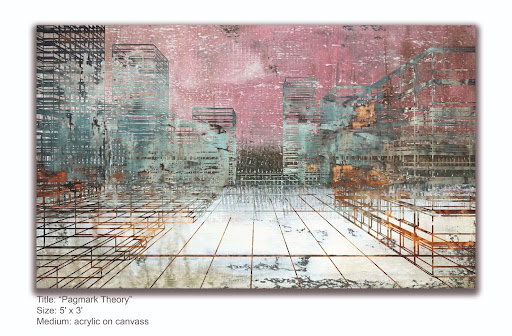
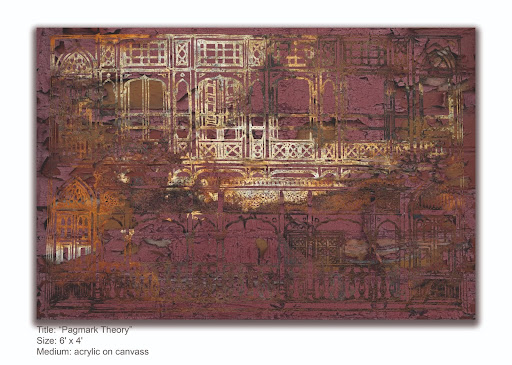
Now, what happened is that I belong to a place called Vapi, in Gujarat. Close to Mumbai, Vapi is one of the biggest industrial zones. It has many chemical factories and pigment manufacturing companies. There is a great deal of pollution and corrosion, and we see corrosion every day.
I began to understand the technique and process of corrosion. I then added my philosophical angle to it. Corrosion is oxidation, and it is not limited to metal. It also happens to us. We oxidize as we age.
Corroded surfaces began to interest me. A surface carries the signature of its process. There is a story behind why and how it changed. Imagine that someone painted a wall pink. When the paint begins peeling, you may discover blue underneath, and then white beneath the blue. These are more than colors. They speak about the time when pink was fashionable, the mentality and taste of the people, and perhaps their financial condition when a certain quality of paint was used.
The surface tells many stories. My interest is in those stories. The surface becomes a medium through which I tell them. This practice developed from the same technique I used when looking at a portrait model during my academic years. I continue to practice it in a different way. It is not seeing new things, but seeing the same thing in a new way.
Ariya: I love that process, and I agree that it's just so interesting to slowly unpack the different stories. My next question is about AI. Since AI learns from content and data that already exists, do you think it can truly help us see something in a new way, or is humanity needed in order for this process of seeing?
Somu Desai: Let me tell you what AI is for me. I think of AI as one of my best friends, a friend who has knowledge from all over the world. I don't ask AI what I should do, but I discuss what I'm doing with AI. It helps me clarify my thoughts.
Before AI, an artist would produce a work and a gallery would ask for a statement. My language is visual. Verbal language is not my language. We asked writers to write statements about our work. A friend might do it without charging, or we might pay someone. Eventually, the writer would produce something based on what he had read. When I received the statement, I sometimes thought, “I have never thought in this manner. What is he writing?” Still, I gave it to the gallery so the exhibition could move forward. We depended on writers.
Now I can return from the studio, take a shower, get ready, and sit with AI. I talk about my process and what I saw in my work. AI has gradually learned the way I think. It helps open things up and expand my circumstances. I do not ask it for solutions. I share my questions and thoughts, and it rearranges them through verbal language. This gives me clarity about my own thought process. This is something I like about AI.
There is one more point that comes to mind. What is art? Art is not a product. Art is a process. That process develops from the experiences of my life. When AI generates an image, it produces an image without having those experiences. If I ask AI to give me the idea for my work, then I surrender the process.
If I consider AI as my best friend, just imagine that AI is a physical person. However rich in knowledge and helpful that friend may be, I would never surrender my life to everything he says. We have to treat AI in the same way. I do not surrender myself. The idea has to be mine. The way of seeing has to be mine. AI can help make my ideas clearer.
I have been thinking about one idea for a couple of years. I am a keen follower of geopolitics, where the word “security” appears often: food security, energy security, and other forms of security. A question came to my mind: where did this idea of security come from? I began speaking with friends who are archaeologists and architects. Their ideas gave me some clarity. Then I started talking to AI and asking questions.
That discussion led me to think about hunter-gatherers and the later development of permanent settlements and agriculture. A hunted animal had to be eaten before the meat spoiled, so people shared it. Human babies take much longer than other animals to walk and become independent, which encouraged people to settle. Once agriculture developed, people could store food for a year. With storage came a stronger concern with possession and security. That same concern continues in the present.
These ideas develop slowly. I use AI to talk through them. I am not ready to produce a work about security. I need to nurture the idea. At some point, it may become mature enough to be exhibited, or it may not. That is the process. The finished product emerges from the process.
Ariya: From my understanding, you use AI as a tool, a partner, and a source of background knowledge, while the conceptual and experiential thinking remains your own. What do you think people today have stopped paying enough attention to?
Somu Desai: People have stopped paying attention because of speed. We have so much to do. We have to reach the office, complete the day’s tasks, report to the boss, perform, and survive.
People’s needs and desires have become very high. The desire to showcase a certain lifestyle has created more demand, and that demand has increased the speed of life. This speed does not allow people to see everything around them.
Instead of looking, people have developed the idea of neglecting. They say, “This is not useful.” But everything around me has a relationship with me: the chair in front of me, the lamp next to me, and my sofa. We bypass those relationships and do not consider them.
Life has become so fast that even a husband and wife may stop paying attention to each other. Forget about seeing the objects around us. People stop seeing and understanding each other within relationships. The speed of life prevents people from seeing deeply.
This connects to my understanding of why people buy artwork. People have a certain lifestyle. They go to the office or factory, maintain their business, work out, and try to meet a certain standard. Their lives become monochromatic. One person may work in a factory, another in an office, another in the stock market, and another in a hospital, but life is still monochromatic.
Artists have not developed that same view of life. They give enough time to seeing things and seeing the world differently. A collector encounters an artist’s work and thinks, “I have never seen this in that way.”
If you show an engineer a brick and ask what it is for, the engineer may say it is for construction and for making a wall. An artist may see the same brick very differently and may want to make a sculpture out of it. Artists have their own ways of seeing.
Collectors want to be part of that idea and own it. Their daily situation may not allow them to live that way, but they may feel, “This is also my taste. This is also my way of looking.” They want to own the artwork because it represents a way of seeing that they value. There are many dimensions to art collecting, including investment, but this is one part I have understood in my own way.
Ariya: What advice do you have for upcoming artists?
Somu Desai: Information is very important in art. I remember when a new book arrived in our library. The principal read it, then the head of the department, then the librarian. After that, senior students had a chance to read it. We had to struggle for information.
The young generation is now well informed because information is so accessible. When something is easily available, however, people may start ignoring it. Rarity gives something importance. When it is readily available, it can lose that importance.
I would suggest that young artists never develop an image simply to showcase themselves as artists. Develop yourself, and let people call you an artist.
Many young artists and students talk with me through messages and phone calls. A first-year painting student from Rajasthan once asked me, “Sir, I want to learn how artists think.”
I told her it was a good question, but first she had to learn how to be a good student. Art will happen. Art is not made. An artist discovers that art has always been there within.
Artists see. They train themselves to see things differently. Read well, understand well, and practice the skills in your curriculum. Improve your drawing.
Think about drawing like a computer system. The eyes take in the data, the brain processes it, and the hand releases it like a printer. A table-tennis player keeps practicing the same movement. A sprinter jogs long distances at a slower speed. Through practice, the action becomes natural. The player does not have to command the hand before every shot. The body responds immediately.
An artist needs the same kind of practice. When an idea comes into the mind, the artist should be able to execute it without struggling with the basic skill. You see something, process it, and release the idea through the hand. That flow has to become smooth.
Develop strong academic practices. Read well. Read about religions. I am not asking you to believe in a religion, because belief is personal. Learn about religions so you can understand cultures. Religion, philosophy, and different traditions will give you ways of seeing.
Young artists should not put all their effort into proving that they are artists. Art is there. It will happen to you. It is like enlightenment. You cannot manufacture an artist.
Artists keep looking at the things which people stop looking at.Somu Desai