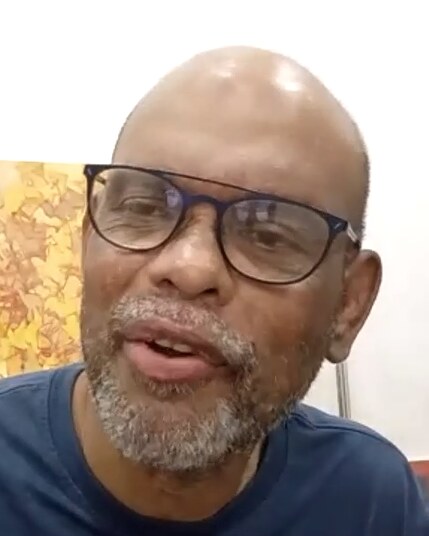
Every period brings a new technology. The camera challenged painters, and industrial development changed society. Artists responded by finding new languages.Sarath Gunasiri Perera
Ariya: Thank you for sitting with me today, Mr. Perera. I would like to begin with a question about the theme In Search of Freedom, which has appeared in your work for several years. How has your definition of freedom changed over time? Has the artwork gradually revealed what freedom means to you?
Sarath Gunasiri Perera: I am sixty-two years old now, and I have had different experiences at every stage of my life: during childhood, at school, as a university student, and later as a teacher.
I grew up in Sri Lanka during the 1970s in a family with very limited means. I say that we were poor, although poverty is relative when Sri Lanka is compared with other countries. We survived through our parents' hard work. They did not have well-paid jobs. They farmed and performed other kinds of village work. If you understand village life in India, then you may recognize a similar experience in Sri Lanka. We received our education without many facilities, and our parents did not have much money to spend on their children's schooling.
When I was at school, I studied music. I still love music, but I also had a special talent for drawing. It did not come from academic training. I simply loved to paint and draw. In 1983, after completing my Advanced Level examinations, I was admitted to the university as a music student. At that time, the institution was known as the College of Fine Arts.
I did not remain in the music program. I approached the authorities and explained that although I loved music, my strongest ability was in visual art. I asked for the opportunity to study painting. They interviewed me and accepted me into the Department of Painting.
The Bachelor of Fine Arts was a four-year degree. I did well, and my teachers took a strong interest in my work. They encouraged me to continue painting. After I completed the degree, I was fortunate to be appointed as a young lecturer. It was a special achievement because no student had received that kind of distinction for around ten years.
While teaching, I took part in exhibitions. Sri Lanka was passing through civil conflict, and it was a difficult period for young people and young artists. In 1992, I helped establish the Sensation Artists Group with seven colleagues. We were very young and did not have much experience, but we managed the group successfully.
In 1993, I went to Banaras Hindu University in India to complete my master's degree. I did not know very much about India before going there, so the country gave me many new experiences.
The paintings in my 1992 exhibition reflected the difficult atmosphere in Sri Lanka. I used a great deal of red, forceful brushstrokes, and an intense palette because it was a turbulent period for the people. After returning from India, my experience was different, and my palette gradually became softer.
I later participated in group exhibitions organized by the government and other organizations. In 2004, four or five colleagues and I formed the Focus Artists Group. I also participated in workshops in India, Bangladesh, Pakistan, and other nearby countries.
In 2013, I organized a special exhibition called *Triplicity*, which brought together my teacher, R. N. Dharmasena, one of my former students, and me. My teacher and I were nonfigurative abstract artists, while my former student was a figurative artist.
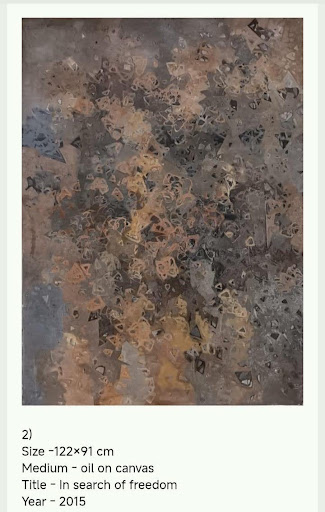
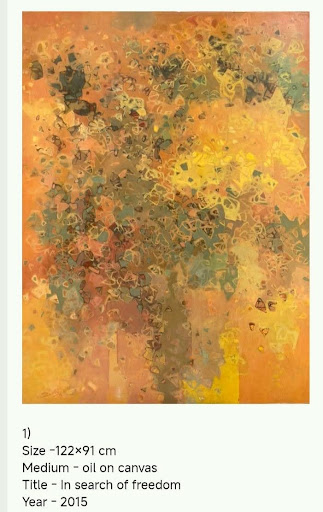
At that time, I had not yet given my paintings the title In Search of Freedom, although the idea was already behind them. I had written about the experiences and concepts informing the work.
A well-known gallery owner visited the exhibition at the J. D. A. Perera Gallery, our university gallery. He arrived near the end of the exhibition and invited me to show my paintings at his gallery in Colombo. He eventually sold more than twenty of the twenty-eight paintings, which helped me greatly because I had paid for the exhibition catalogues and organizational expenses.
He interviewed me about the work. He asked where the colors, brushstrokes, abstract elements, and experiences came from. I told him about my childhood, university life, and social and political experiences. After listening, he said, “Mr. Sarath, let us call your exhibition In Search of Freedom.”
The freedom I describe is not purely political. It is an inner feeling. In Sri Lanka, many people are Buddhist. In the villages, we lived peacefully and did not struggle against one another, yet we still searched for an inner freedom. That search gradually entered my heart and my work.
At the same time, Sri Lanka experienced terrible civil and political violence, particularly between 1987 and 1989. It was a painful experience because many young people died or were killed.
Little by little, those events led me to books about existentialism, anxiety, and the search for meaning. Hermann Hesse's *Siddhartha* became important to me. Do you know Hermann Hesse.
Ariya: Yes, I have heard of him.
Sarath Gunasiri Perera: Siddhartha draws upon Indian philosophy and Buddhism. It is a very interesting book. Hesse suggests that to find freedom, we must discover and follow our own path. The novel echoes elements of the Buddha's life, but Siddhartha's journey is distinctly his own. He seeks understanding through personal experience.
There were also many existentialist artists, writers, dramatists, and philosophers. Arthur Schopenhauer developed many related ideas through his philosophy. Gradually, I began reading about the lives, ideas, and experiences of these thinkers. I found connections between their ideas and our own experiences.
Many dramatists, novelists, and artists have drawn inspiration from these philosophical concepts. Here in Sri Lanka, we also have Buddhism and Hinduism, which teach us to live peacefully and harmoniously. My thinking gradually changed. People often focus on the body and its beauty, but Buddhism and many philosophers explain that nothing is permanent or singular. The body consists of many small elements and is constantly changing.
This understanding changed the way I portrayed the human figure. As a young student, I was very interested in painting portraits and landscapes. Eventually, I began to feel that painting a fixed portrait was somehow meaningless because a person changes every day. Let me show you one of the portraits I made. This is my sister.
Ariya: Oh, this is your sister?
Sarath Gunasiri Perera: Yes, my own sister. I painted it as a student in 1987, but it has since been damaged.
Ariya: Wow. Is it on loose canvas?
Sarath Gunasiri Perera: It has become loose because it was damaged. At the time, I was only a student and did not know whether I would become a lecturer or a professional artist, so I did not take proper care of it.
In our third year, we were influenced by Indian miniature painting. I think some of its qualities remain in my work today, especially in my colors, compositions, and tiny details. One of my teachers guided me closely. As students, we had to study Sri Lankan traditions, including temple painting, as well as the art of India and China. Without learning those traditions, I could not have reached my present position.
Ariya: Your earlier paintings and portraits contain recognizable narratives, yet your abstract works still communicate considerable emotional depth. What can abstraction express about freedom that figurative painting cannot?
Sarath Gunasiri Perera: The freedom I am speaking about exists within us. To discover it, we have to release many of our attachments to the outer world. It is difficult to explain fully, but as a Buddhist, I believe there is nothing permanent here.
We have to turn toward our inner world to understand these things. Otherwise, we suffer while pursuing luxury and material possessions. The Buddha also lived a luxurious life before deciding that it offered no lasting meaning and could not end suffering.
As artists, we cannot necessarily separate ourselves from our families, children, and responsibilities. Understanding is more important. It allows us to endure difficulties. Political and economic crises occur every day, especially in our part of the world. People struggle and compete constantly. I do not want to participate in that kind of competition.
My childhood, background, and experiences with students, teachers, friends, and the art world changed me. Competition can cause great suffering. I do not compete with other artists. As a teacher, I encourage students to think for themselves and discover their own concepts. They should not simply follow other people. The concept lies within the artist. A teacher can guide its development, but the artist must discover it.
Ariya: Having spent decades teaching artists, what misconception do your students and other young painters commonly have about originality and developing their own voices?
Sarath Gunasiri Perera: A foundation in academic practice is very important for young artists. They need a basic understanding of art and must study traditions from Europe, India, Sri Lanka, and elsewhere. Without that practice, it is difficult to develop a mature individual standard.
I love American Abstract Expressionism of the 1940s. Artists such as Jackson Pollock, Willem de Kooning, and Robert Motherwell responded to experiences surrounding the Second World War, but they also had strong training. Pollock had an academic foundation before developing his mature work.
Our teachers encouraged us to study artists such as Picasso, Braque, and Van Gogh. Today, the situation has changed. Contemporary and postmodern artists often emphasize their individual concepts, but we were taught to study particular artists and traditions first. We also studied Ajanta, Jamini Roy, K. G. Subramanyan, and the Sri Lankan painter George Keyt, who was also well known in India.
Gradually, I arrived at my present practice, but I am still searching for freedom. The title itself says that the search continues.
Ariya: Does music inspire many of these works.
Sarath Gunasiri Perera: It provides a great deal of inspiration. The paintings are fragmented and contain no specific forms. They may suggest a landscape, the sky, the universe, or the interior of the mind.
I enjoy working with fine details. As a teacher, I encourage my students to study nature and its beauty. There are many fascinating things to learn beyond the human figure. Unfortunately, Sri Lanka does not always provide artists with the support they need.
My early works were very different. The difficult experiences of the 1980s entered them as concepts. The paintings I made for my 1992 exhibition used strong colors and forceful brushstrokes. It was a terrible period for parents and young people, and one painting contains the figures of a mother and child. Other paintings from the exhibition show my gradual movement toward nonfigurative abstraction.
Ariya: As you move closer to the painting, I can see more details. It is remarkable.
Sarath Gunasiri Perera: Some of the small elements appear to float through the sky. They were partly inspired by dry leaves moving through the air without visible support. I began to see them as an image of freedom, like kites without strings.
I also made many sketches. It was impossible to reach my present practice immediately. This is why I tell my students that experience and sustained work are necessary to develop a concept.
Ariya: So artists need technique, precision, and close attention to detail.
Sarath Gunasiri Perera: Yes, they need a great deal of detail. Abstract Expressionism did not generally emphasize detailed painting in this way, but I approach abstraction as an Asian artist with a deep interest in Indian miniature painting. Our experiences are different from those of artists in the United States. People here may face poverty and economic crises, but they often meet those problems quietly.
Ariya: As technology, particularly artificial intelligence, increasingly shapes the images we consume, what concerns you about its effect on art and artists? If AI can imitate a style, where does originality truly reside?
Sarath Gunasiri Perera: New technologies have challenged people throughout history. Industrial development changed society, and Charlie Chaplin explored its effect on human beings in films such as Modern Times. The invention of the camera also created problems for painters, but artists responded by changing their approach. Impressionism developed, and artists such as Picasso transformed portraiture and moved toward abstraction.
Artificial intelligence is another modern development. It creates a form of competition, and artists will have to respond to it. AI cannot do everything. Human touch and the human mind remain very important. A machine may imitate a style or absorb influences, but it cannot reproduce the full human experience behind a painting.
New discoveries have appeared throughout history and prehistory, yet people have continued to survive and create. Abstract and realist artists are still working, and people still value and buy their paintings. I am not afraid of AI, although it will challenge us.
Ariya: Time and again, new technologies appear, and people learn to adapt to them.
Sarath Gunasiri Perera: Yes, we have to adapt and respond. Human beings will continue to survive.
Ariya: Is there one book you believe every young artist should read.
Sarath Gunasiri Perera: Many books are available, but artists must first think deeply about themselves. Their most important book is within their own hearts. They have to read their backgrounds, their parents, and the experiences that belong to them. No external book can provide all the guidance they need. They must learn to read themselves honestly.
Historical writing and other books are valuable, but a genuine artist must follow his or her own experience. Artists lose that genuineness when they merely imitate someone else. Influence can be helpful, but copying is harmful. Today, AI makes it easier to copy, alter photographs, and edit existing material, which makes self-knowledge even more important.
People in India and Sri Lanka possess their own political histories, cultures, and ways of life. These experiences are valuable. Thinkers such as Osho wrote about releasing attachments and finding oneself. Some of his ideas may appear extreme, but they can be valuable when read with care and understanding.
India has long been a source of philosophical and spiritual knowledge. People from other countries have traveled there to encounter Hinduism, Buddhism, Jainism, and related traditions. Rabindranath Tagore is also important to read. I admire him greatly. He drew deeply upon the experience of India.
Ariya: Yes, definitely. I agree.
Sarath Gunasiri Perera: Tagore was a highly intelligent writer, poet, dramatist, novelist, and artist. He began painting later in life because he understood that art contains something profound. Other members of his family were artists as well.
Art concerns more than aesthetics. It is also a form of philosophical inquiry. Through painting and lived experience, we learn to read and analyze the world.
Ariya: Thank you for allowing me to interview you today. This has been wonderful.
Sarath Gunasiri Perera: Thank you. I would be happy to support you and provide more information if you need it. I may not have expressed everything as fluently as I wished because we do not often have opportunities to speak English with others. Sinhala is our first language and the language in which we teach at the university.
Please continue your studies, Ariya. We will help you from here if you need support, and I will share any useful contacts or information with you.