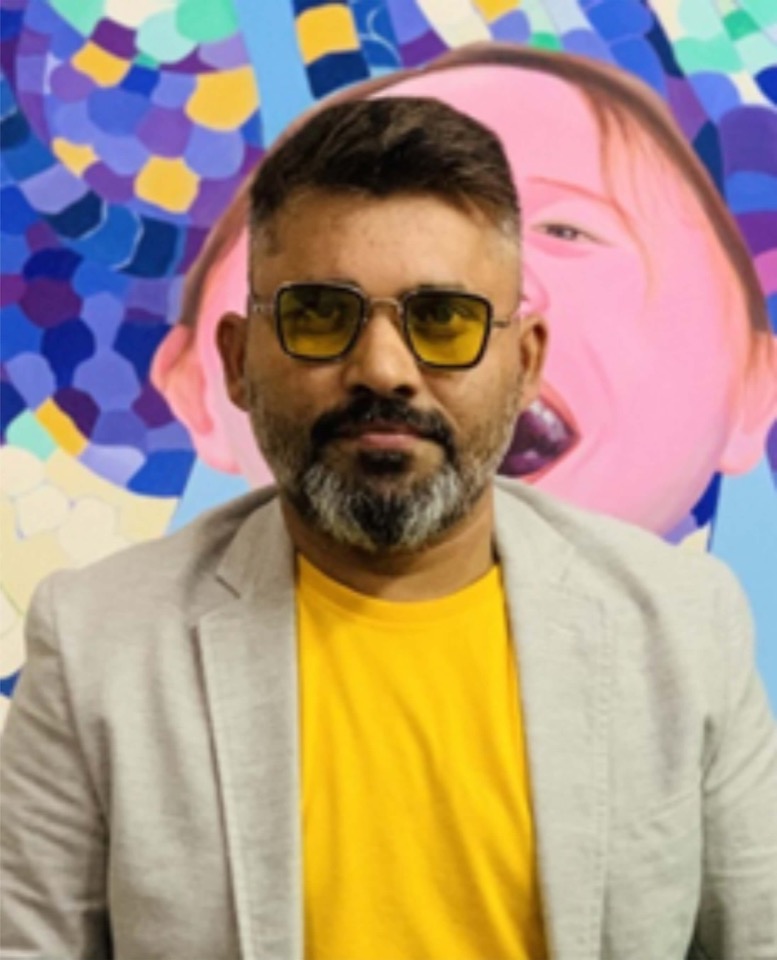
After you are fundamentally strong and have gained the basic skills, use technology.Sambit Kumar Panda
Ariya: In some of the documents that you sent, you wrote that ideas shape identity and that identity sharpens ideas. Do you think that we discover who we are, or do we create who we are over time?
Sambit Kumar Panda: That is a very good question. I think I wrote that statement in 2016. I am curious to know everything beyond drawing and creating. Gradually, my ideas have shifted, and my statement is now a little different. Through different phases, we learn many things, and the world is moving fast. For example, I can mention AI. The generation has changed.
Identity is crucial in art practice. When you search for identity, you have to go back and research it again. You are forever questioning and evolving.
Ariya: You have also talked about how rituals are repeated by generations, although every person experiences them differently. What keeps a tradition alive: repeating it faithfully or allowing its meaning to change over time?
Sambit Kumar Panda: If we forget our traditional practices and follow only the practices of a different generation, we forget our roots, traditions and culture. Those things should be integrated into our practice. That makes the practice authentic.
It does not mean that you have to stick to whatever traditional practice exists in your local area, region or a particular place. While you need to explore and connect and integrate it with the wider world of practice, you should also study practices in your region. Then your artwork can reach a national or global standard.
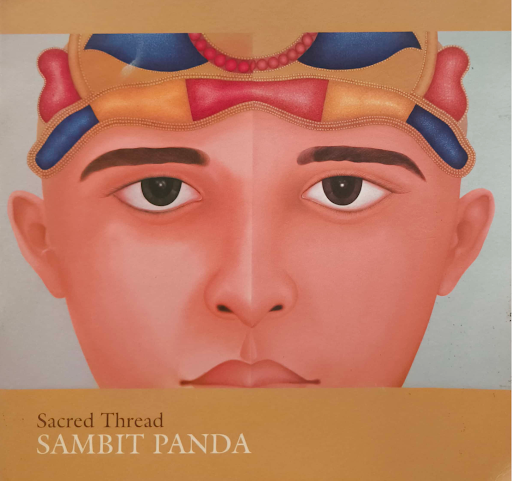
In 2009, I made a project called *Sacred Faith*. In that project, I tried to portray the regional practice of Brahminism in Odisha, which is part of India. If you go to very remote areas, people still practice it rigorously. They use the sacred thread, *janeu*, and they are very spiritual. At the same time, Brahmin families also follow very modern practices. I was fascinated by that, so I tried to present their practice in a modern way and from my point of view.
For the exhibition, I wore the attire used in that practice and performed in a busy area of Delhi. Many people gathered because they were curious about what was happening. I tried to convey how traditional regional practice remains relevant in society. People asked me questions, and I included a video presentation of the performance in my solo show.
Ariya: In some of your work, you have used creatures that people normally try to get rid of, including houseflies, as important subjects. What can something unwanted tell us about people? Why did you choose those subjects?
Sambit Kumar Panda: I have been asked this question many times because these are very unusual elements. The philosophy is connected to human ignorance. Houseflies, honeybees, dragonflies, and many other insects were part of my drawings and paintings during the period from about 2000 to 2010.
I shifted from Bhubaneswar in Odisha to Delhi. The culture was different. The language and food practices were also totally different. I found that many people in Delhi were moving quickly through life.
When I worked near the river, I saw many people catching fish in a traditional way. Dead fish were floating in the water. The fishermen were still catching fish and trying to sell them in the market. I questioned why they were doing this. What was going to happen if the fish were sold in the market? People are very busy; they never pause to think about what might happen.
I thought these small things showed human ignorance. I decided to make them larger than life so I could make some people aware of them. I made thousands of drawings.
When I exhibited the work, many people were curious. They asked why I had drawn such tiny flies at life-size scale and used the entire gallery wall to display them. That was my challenge. People interacted with me and began to pause and notice.
Ariya: You have spoken about how your father encouraged you to become an artist, as well as the teachers and other artists who shaped you. Is there a lesson one of them taught you that you only understood later?
Sambit Kumar Panda: This is very personal. When I graduated, my father wanted me to attend a fine-arts college. The place where I come from in Odisha is very remote, and there was no fine-arts college. We had to follow the traditional way of education. My father always inspired me to go to a fine-arts college because I had strong skills in drawing and painting. He told me not to spoil that.
My father was also an artist. From childhood, I received inspiration from him. I learned an interesting technique from my father that I never learned from my academic institutions.
Gradually, I shifted to Bhubaneswar, the capital of Odisha, and gained admission to B. K. College of Art and Crafts for my bachelor’s degree. My professors taught me different approaches to art. I learned techniques, art history, and philosophy. I had never thought that there was philosophy in art. Initially, I did a lot of drawing and painting in a very flat way. I never thought beyond that layer.
Then I shifted to Delhi for my master’s degree, and my perception changed completely. What I had learned in Odisha was skill-oriented. I had very good drawing skills, and I felt proud of them. That pride shifted a little in Delhi. I understood that I had to use my skill in a concentrated way. What I wanted to say and my method needed to be clear.
I went to many galleries and museums repeatedly because I was curious to know more. Senior artists and senior friends who were mainstream artists at that time helped me understand what was happening in art practice.
Another big achievement came in 2011, when the Government of India sponsored shows for me in three European cities: London, Berlin, and Madrid. It was an exchange program through the Indian Council for Cultural Relations. I presented solo shows there, and my perception changed again.
In London, the practices were totally different. Artists were using code and unconventional materials in their art practice. I had never thought about that. We carried our own art traditions and used materials that were easily available. There, I understood that a material has a language. If that language matches your concept and theme, it will be great. My work has gradually continued to evolve.
Ariya: Your artistic identity grew through different experiences and relationships. AI has not had those kinds of experiences. Can it ever develop something we could call an artistic identity?
Sambit Kumar Panda: AI has a vital role in art right now, and not only in art. During my undergraduate years, our teaching was very stereotyped. Digital resources were unavailable. We were eager to go to the library for textbooks or see a demonstration by our teachers. Our information was limited unless we went to a museum or exhibition.
For this generation, AI is a game changer. I struggled at that time to write my own synopsis. Whatever knowledge I had gained and whatever I had explored, it was difficult to communicate it. I had to rush to a professor for help. Now AI is a super guide. You can use it for assistance.
If you want to incorporate something into your style, you can search through AI. Many things are available, and you can get good references. AI will be very helpful for this generation. We are also getting help from it.
Ariya: What about ownership? If AI makes an image that looks completely new, is that the same as having a new idea, or is it plagiarism?
Sambit Kumar Panda: In my experience, AI does not give an artist a new idea. Whatever we prompt and whatever is already in our art field, AI provides it to us in an articulate way.
What you are thinking in your mind is the biggest thing. Sometimes multiple thoughts come into our minds. We hold those thoughts and convert them into a layout or artwork. In my experience, AI cannot recreate or generate those multiple thoughts.
AI can definitely be helpful. If you are not satisfied, you can give it guidance: “I want this type of thing. I do not like this one.” Then AI will use your prompt to give you useful information. I think it can be integrated into the process.
Ariya: Okay, so it is integrated into the process. It is more like a tool, a facilitator. So I am wondering, what advice do you have for upcoming artists who are trying to establish themselves?
Sambit Kumar Panda: Digital tools are everywhere. The younger generation is using digital platforms like AI, ChatGPT, or Midjourney. The main thing is that you have to practise and develop practical, physical skills. Those skills will be highly important.
You have to go and observe how people behave. Look at their gestures, then sketch and paint them. After you are fundamentally strong and have gained the basic skills, use technology. It will be helpful.
My generation received these technologies very late. The younger generation is getting technology faster than we did. Basic skills are still required. If they can balance those things, the new generation of artists will do fantastic work very easily.
Ariya: What gives you hope about the next generation of artists and creatives in an age when so much critical thinking is automated?
Sambit Kumar Panda: For the past two decades, we have had to attend every event, gallery exhibition, and opening to get information. Now, however, the younger generation has instant information on mobile phones. While they have access to information, they miss out on the practical experience of seeing the artwork.
I think things will gradually change. They will understand the value of being physically present and seeing art in person.
Ariya: Is there a book you would recommend to artists, or a favorite book you would like to mention?
Sambit Kumar Panda: G. R. Iranna. One more artist is Pratul Dash. They are contemporaries of mine..
Ariya: Thank you so much for meeting with me today and talking with me. I found your materials and background fascinating. Thank you for allowing me to pick your brain.
Sambit Kumar Panda: Thank you. Good luck. It was nice to meet you.
For this generation, AI is a game changer.Sambit Kumar Panda