AI was made to serve us, to inspire us, to activate us; not to overcome us or override us. And what role does art play in that? Art is often the truth.Nell Merlino
Ariya: You are an activist, an artist and the founder of Take Our Daughters to Work Day. How did art first enter your life?
Nell Merlino: I have made art during periods of transition in my life. It has been extremely helpful in communicating what I was feeling.
I was born in the 1950s, so I have lived through the advent of different technologies. My first sustained period of making art came during a major transition. I was going through a divorce after 25 years of marriage, and my professional life was changing. The art began to emerge spontaneously. I started putting things on the walls of my office, which was becoming my home. As I unpacked boxes, I arranged objects and images I loved. Some of those arrangements had the feeling of collage.
After September 11, I began making elaborate shrines inspired by Mexico’s Day of the Dead traditions. Later, in 2018, when more women entered Congress than ever before, I created a very large shrine that people came to see.
Only recently did I remember an earlier beginning. When I moved from eighth grade to high school, I went from a coeducational Catholic school to an all-girls Catholic school. For a while, I lost the ability to write. I simply could not do it. Fortunately, I had an English teacher who told me I could respond to assignments with pictures. I made collages, sometimes using words cut from magazines like the letters in a ransom note. As long as I could explain the picture and remain connected to the subject, she accepted it. Art has been extremely helpful to me to communicate what I was feeling.
Ariya: How do you choose the women you portray in your elaborate portraits?
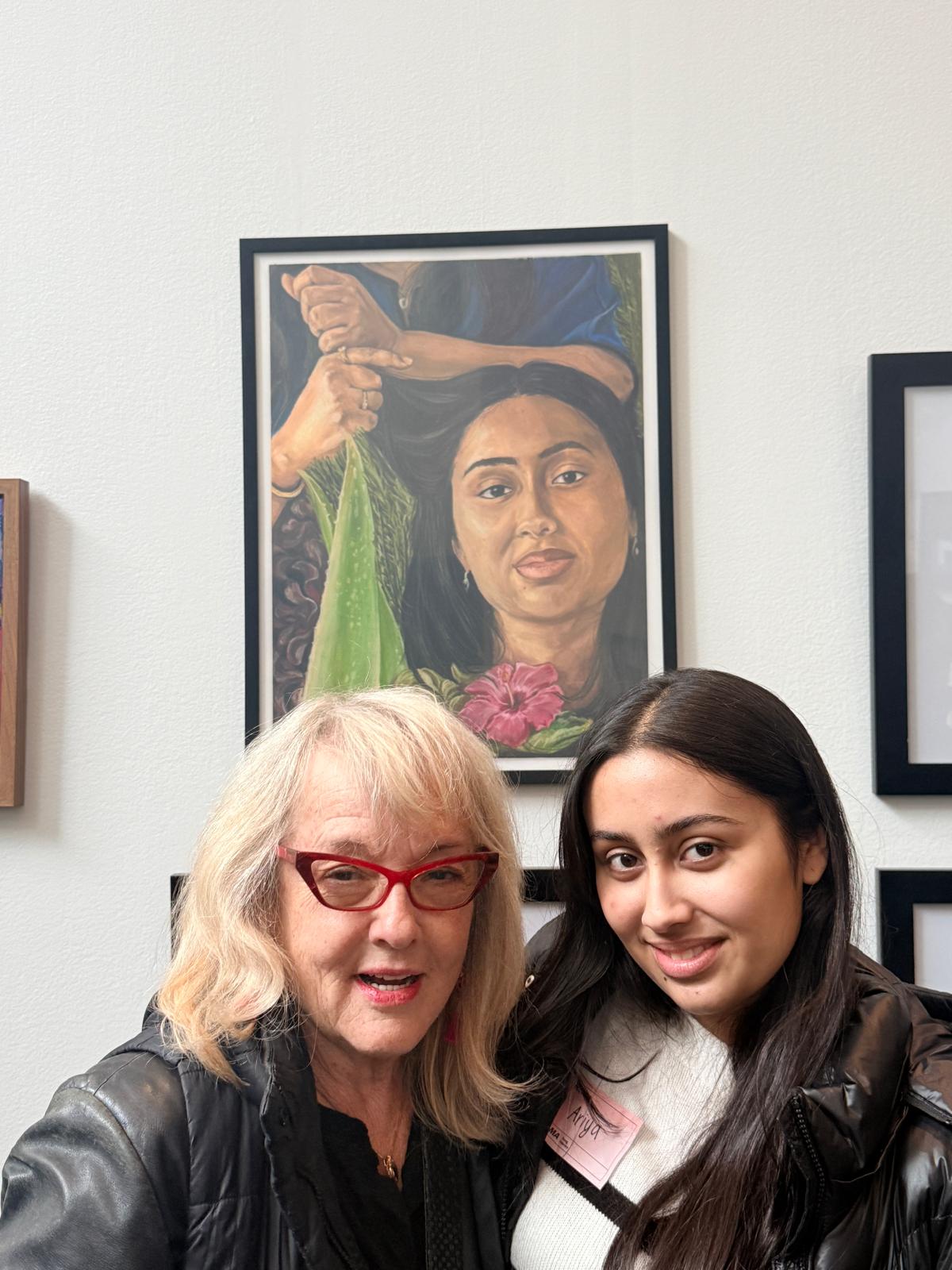
Nell Merlino: I began with people I love dearly. The first portrait was of my niece. I had taken a photograph of her when she was 12, on a day when we had an argument. She spoke to me with an anger I had never heard from her before. What she was saying mattered deeply to both of us, and I realized I had missed this emerging part of her personality.
The portrait is called Pearls of Wisdom. It became a story about a young person developing her power.
After that, I made several portraits of myself. When people saw them, they began asking me to make portraits of them. The first person who saw Pearls of Wisdom was a woman with a large art collection. She immediately said, “I want one.” In that sense, many of my subjects chose me.
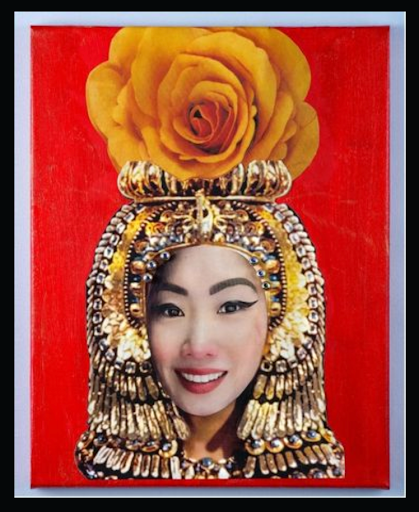
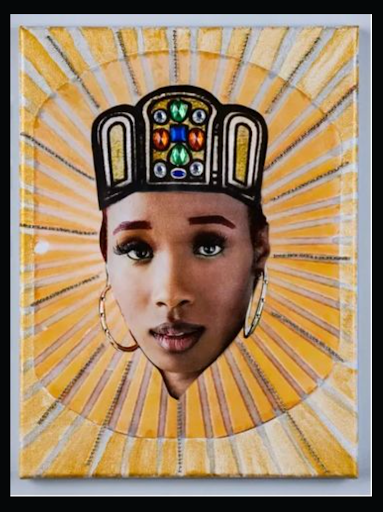
I have also made portraits of public figures I admire, including Kamala Harris and Anita Hill. I am drawn to women who have accomplished a great deal and have never created an image of themselves that expresses the scale of those accomplishments.
Women are always being encouraged to improve themselves. We rarely feel finished. Yet we have achieved things that deserve a moment of recognition. Historically, portraiture marked victories, coronations, marriages and positions of power. Men who won battles were immortalized on enormous canvases. Women deserve images that honor where they have shown up for themselves and for others. I needed that kind of honoring in my own life.
Ariya: What do technology and society misunderstand about creativity and what it means to be an artist?
Nell Merlino: I can speak for myself. Art expresses how I feel through the particular form I have chosen. I want to represent women in ways we rarely see. I want to show accomplishments that belong to their beauty and power as real people, beyond the polished versions presented by magazines, television and social media.
I am interested in the whole person: what she has achieved, what she has survived and how she has met the challenges in her life. We do not see enough art about women that reflects that fullness.
There are many lovely paintings of women with children, and motherhood is important. Women also inhabit countless other roles and experiences. My question is how to bring all of that into a work of art. How do we show women in their totality?
Ariya: You have built campaigns around helping women and girls become more visible, valued and heard. Where do artists face similar struggles for visibility and recognition in the age of AI?
Nell Merlino: We are confronting a familiar set of issues. For years, people counted how often women appeared in newspaper stories, television news and broadcasting roles because the public face of those institutions was overwhelmingly male. There has been progress in who delivers the news. When it comes to AI, the images of women we encounter still often come from systems shaped without enough women’s perspectives.
Look at the composition of many technology companies. The people building these systems are still predominantly young men. Women’s knowledge and experience are entering at a different rate.
This connects directly to The Female Gaze Project. Most of the images we see of women were made by men. That is true in museums, magazines, television and film. In 2026, Autumn Durald Arkapaw became the first woman to win the Academy Award for cinematography, for Sinners. Women cinematographers have worked for years, but that milestone reveals how narrow the field has remained.
We are constantly receiving an interpretation of the world through a limited set of eyes. A richer visual culture would include more women portraying women, more women portraying men, and a wider range of people interpreting human experience.
Women artists need to place more of their work into the world. AI may offer an opportunity to share and discover that work. I would love to see an exhibition of self-portraits by women across history. Van Gogh painted himself dozens of times, and those images are familiar to millions of people. How many women artists also made self-portraits that remain in archives or vaults? What could we learn from the ways they saw themselves?
AI might help locate and organize those works. Imagine curating such an exhibition with the technology, bringing scattered portraits together and giving them the attention they deserve. That would be extraordinary.
Ariya: Take Our Daughters to Work Day helped young people imagine themselves in places where they might not have felt welcome. What creative or technological spaces do artists need access to now?
Nell Merlino: Artists need to be in the rooms where AI is being made. Graphic artists are already present in some of those spaces, thank goodness. We also need musicians, dancers, theater artists, painters, sculptors and people working across every creative discipline.
Women in those fields must help shape this intelligence so that culture moves forward with us included. We need to insist on our presence and contribute enough material that these systems recognize who we are and what we do.
I have only begun to explore what might be possible. AI could help organize exhibitions, sort large bodies of material and locate works across institutions. Where is a particular painting? Who owns it? Whom do we contact to bring works together? Those questions can be difficult for any curator.
In my first six weeks of using Claude, I found its organizational capacity astonishing. I have organized millions of people, so the possibilities make me feel like a child in a candy store. The questions we ask these tools could help us confront fundamental issues about how culture and society move forward.
Ariya: What support systems do artists need right now?
Nell Merlino: Artists have recently lost a great deal of support. Funding that once existed needs to be restored, including support through the National Endowment for the Arts.
We also need serious conversations about work made digitally and work made by hand. Universities are examining how students write papers in the age of AI. The art world needs to ask comparable questions. How was a work produced? What are you buying? How much comes from a person’s feelings, decisions and physical labor? How much comes from a pattern generated by a machine? Does that change our experience of beauty? I do not have complete answers.
Artists need access to current technology, along with opportunities to speak honestly about how they use it. Where does it help? Where does it interfere? Where does it narrow their creativity? The people who make art should lead that inquiry because they bring the experience of making things and see the questions through a different lens.
Some technologies still struggle to read faces. That raises questions about what happens to portraiture. The human eye, mind and spirit seek something beyond a photographic likeness. I certainly do.
Ariya: What do artists need to see, question or challenge now?
Nell Merlino: The question becomes complicated because there are so many forms: video, music, painting, theater, dance, textiles and countless others. Human beings have made images since cave paintings. We now have the ability to trace how those forms evolved and how they led to a moment when a program can produce an elaborate mural in five minutes.
What does that generated mural carry when placed beside a mural made in Pompeii thousands of years ago? How does artificial intelligence understand the artifacts people have left behind? How does it interpret human self-expression?
Art is a record of history and of individual existence. It also records feeling. Artists need to express, appreciate and preserve that dimension of human experience. We need clarity about who we are, what we value and what we consider sacred. Then we must find ways to give those convictions form.
Perhaps because of my age, I feel a responsibility to keep things real. AI still feels unreal to me, although I am fascinated by it. I am excited about the opportunities it presents, provided it does not become more important than the people it was created to serve. I believe technology should inspire and activate us. It should remain in service to human life.
Art has a role in protecting that relationship because art can tell the truth. The great historical paintings of battles became records of what happened and how an era wished to remember itself. Artists must continue making that kind of record.
Ariya: Do you think AI can achieve creativity?
Nell Merlino: We first have to decide what creativity means. A machine can copy many things. Whether it can interpret how an experience makes it feel is another matter. My instinct is no, although I cannot claim certainty.
Several years ago, I visited a robotics exhibition at the Science Museum in London. It traced robotics back to the fifteenth century. One early mechanical figure had been created after a Spanish king’s son injured his leg. The doctor needed to demonstrate exercises that would help the boy recover, so a device was built to show him the movements.
At the other end of the exhibition were Japanese robots designed to work as home health aides. A curator who knew I was a feminist approached me quietly. She asked whether I had noticed that every caregiving robot had been given a woman’s voice. I had not. Once she pointed it out, I heard all those sweet, feminine voices and thought, here we go again.
Caregiving is a human role. Men are nurses, doctors, husbands and family caregivers. When technology repeatedly feminizes care, it carries an old stereotype into the future. Women need to be present in every room where such decisions are made, asking why the machines sound the way they do and whom those choices serve.
Questions of value extend into art history. Women have long made objects that combine beauty with function: plates, bowls, clothing, blankets and the spaces where people live. Weaving represents thousands of years of technical and artistic achievement, yet it has often been dismissed as domestic work or craft. These objects shape our visual lives every day. We need to reconsider how culture assigns value to them.
Ariya: What gives you hope about the next generation of artists and creative people at a time when so much artwork and critical thinking can be automated?
Nell Merlino: People want to express themselves. They want to understand themselves, and they want to be known. That desire gives me hope.
Artists may eventually have portfolios that include work made by hand, work created with AI and work informed by AI-assisted research. A tool might suggest a color palette or help someone discover a color they have never mixed before. Animation may embrace these technologies quickly. Music raises other questions. Could AI write a love song that truly makes people cry? Perhaps. I do not know.
Human beings will continue finding ways to stand out. Individual expression cannot flourish if everything looks and sounds the same. The feeling a person invests in a work still matters.
I am sure someone could use technology to imitate the mixed-media portraits I make. I do not even use Photoshop because it changes the depth of the work. My portraits contain physical layers of paper, and those layers matter to me. Every artist will have to decide what matters within their own process.
I remain open. I have always had faith in the future. I have lived through enormous change, and I believe we can continue adapting. We are at a precipice, and the challenges facing our society belong to citizens, artists and institutions alike. They can be addressed.
I have great faith in the human spirit. Joined with the energy of youth, that spirit can be monumental. I am banking on that.
I have great faith in the human spirit. The human spirit with the energy of youth can be monumental. So I’m banking on that.Nell Merlino